
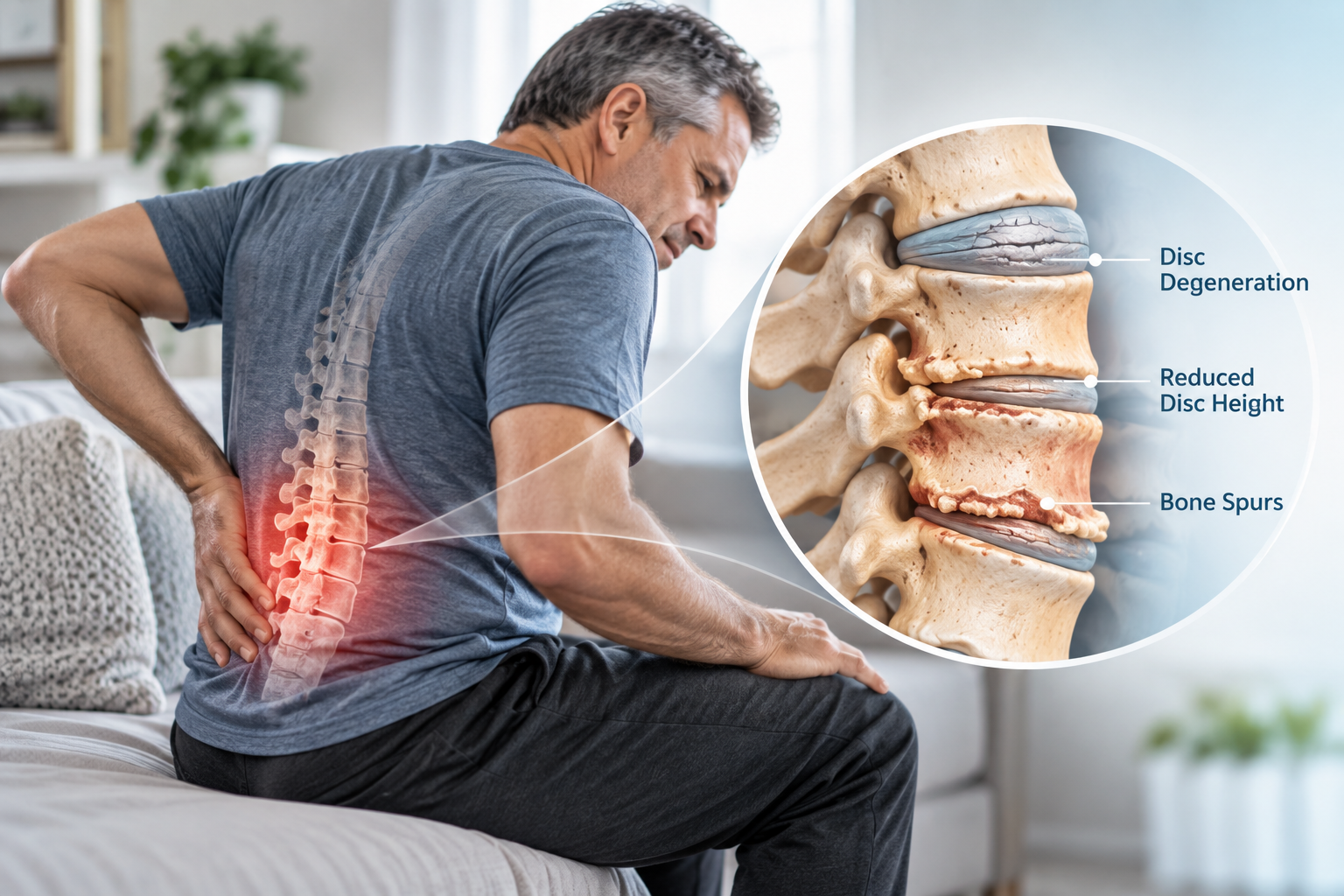
As we get older, changes in the spine can happen gradually. Sometimes, those changes occur without causing noticeable symptoms at first. In other cases, subtle discomfort, stiffness, or changes in mobility may be early indications that the spine is beginning to experience age-related degeneration.
At Complete Performance Chiropractic, we believe understanding these early warning signs can help people become more proactive about their spinal health. Degenerative spine conditions such as degenerative disc disease, spinal arthritis, degenerative joint disease, bulging discs, and spinal stenosis can affect how comfortably you move, work, exercise, sleep, and participate in everyday activities.
The good news is that experiencing spinal degeneration does not automatically mean surgery is necessary. A comprehensive evaluation can help identify what may be contributing to your symptoms and determine whether conservative, non-surgical care may be appropriate.
What Are Degenerative Spine Conditions?
Degenerative spine conditions describe changes that can develop in the structures of the spine over time. The spinal discs, joints, bones, ligaments, and surrounding tissues can all experience changes as part of the aging process.
One common condition is degenerative disc disease (DDD). Despite its name, DDD is not necessarily a disease in the traditional sense. It often refers to age-related changes in the spinal discs, including reduced flexibility, changes in disc height, or loss of disc hydration.
Another common concern is spinal arthritis, which may develop as the joints of the spine change over time. Degenerative joint disease can contribute to stiffness, discomfort, and reduced range of motion.
Some people may also develop bulging or herniated discs. In certain situations, changes around the spine can contribute to irritation or compression of nearby nerves, potentially resulting in symptoms such as sciatica, numbness, tingling, or radiating pain.
1. Morning Stiffness That Takes Longer to Go Away
One of the earliest warning signs of degenerative spine conditions may be stiffness after waking up.
You might notice that getting out of bed requires more effort than it used to. Perhaps your lower back feels tight when you first stand, or your neck needs several minutes of movement before it feels comfortable.
Occasional stiffness can happen to anyone. However, persistent or progressively worsening stiffness deserves attention, especially when it begins interfering with normal activities.
Morning stiffness may reflect changes in spinal joints, discs, muscles, or other surrounding tissues. Rather than simply accepting increasing stiffness as an unavoidable part of getting older, it can be helpful to have the underlying cause evaluated.
2. Back or Neck Pain That Keeps Returning
Another potential warning sign is recurring pain.
You may feel fine for several days and then experience discomfort after gardening, lifting something, sitting for a long period, walking, or exercising. The pain may eventually settle down, only to return again later.
Recurring symptoms can sometimes indicate that an underlying mechanical or degenerative issue has not been fully addressed.
At Complete Performance Chiropractic, our approach begins with understanding the individual rather than treating every case exactly the same way. Chiropractic care may be appropriate for some patients to support spinal joint mobility and function, depending on their condition and examination findings.
3. Reduced Range of Motion
Have you noticed that turning your head while driving is more difficult? Maybe reaching overhead feels restricted, or bending forward to put on your shoes is becoming uncomfortable.
Reduced range of motion can be another sign that something is changing within the musculoskeletal system.
Degenerative changes may affect the mobility of spinal joints and surrounding tissues. Pain can also cause people to move differently, creating additional stiffness and compensation patterns.
A functional assessment can provide valuable information about how your body moves rather than simply focusing on where it hurts.
At Complete Performance Chiropractic, movement and function are important parts of understanding a patient’s overall condition. Looking at posture, mobility, strength, flexibility, and movement patterns can help guide an individualized approach.
4. Pain That Travels Into an Arm or Leg
Pain that travels away from the spine deserves particular attention.
For example, lower back problems may sometimes be associated with pain traveling through the buttock and into the leg. This pattern is commonly associated with sciatica or irritation involving the lumbar nerves.
Similarly, problems in the cervical spine may contribute to symptoms extending into the shoulder, arm, or hand.
Radiating pain can sometimes occur when spinal structures place pressure or irritation on nearby nerves. Numbness, tingling, burning sensations, or weakness can also occur.
These symptoms should not simply be dismissed as normal aging. A professional evaluation can help determine whether the symptoms may be related to the spine or another condition.
5. Increasing Difficulty With Everyday Activities
Degenerative spine conditions do not always announce themselves with severe pain.
Sometimes the first noticeable change is functional.
You may find yourself avoiding long walks because your back becomes uncomfortable. You might stop playing golf, gardening, exercising, traveling, or picking up grandchildren because certain movements no longer feel comfortable.
These changes can happen gradually enough that you may not immediately recognize them as warning signs.
Our goal at Complete Performance Chiropractic is not simply to focus on pain levels. Maintaining mobility and helping patients continue participating in meaningful daily activities are important parts of comprehensive spinal care.
6. Pain or Stiffness After Sitting for Long Periods
Modern lifestyles often involve prolonged sitting. Working at a desk, driving, watching television, or using electronic devices can keep the spine in one position for extended periods.
If your lower back or neck consistently becomes uncomfortable after sitting, it may be worth investigating.
Poor posture does not automatically mean you have a degenerative condition, but prolonged static positioning can contribute to mechanical stress and discomfort. Existing spinal changes may also make certain positions more difficult to tolerate.
Regular movement, appropriate ergonomic adjustments, and an individualized evaluation can all play a role in supporting spinal health.
7. A Gradual Decline in Strength or Stability
Changes in strength, coordination, or balance can have many potential causes, so they should not automatically be attributed to spinal degeneration.
However, when these changes occur alongside back pain, neck pain, numbness, tingling, or radiating symptoms, they deserve professional attention.
Nerve irritation or compression involving the spine can sometimes affect muscle function. Identifying the source of these symptoms is important because treatment should be based on the underlying problem rather than simply the location of discomfort.
If you experience sudden or significant weakness, loss of bladder or bowel control, numbness around the groin or saddle region, or other severe neurological symptoms, seek prompt medical attention.
Why Early Evaluation Matters
One of the biggest mistakes people can make with chronic back or neck discomfort is waiting until symptoms become severe before seeking an evaluation.
Early symptoms do not necessarily mean serious spinal disease. At the same time, persistent changes should not automatically be accepted as something you simply have to live with.
An evaluation can help distinguish between muscular discomfort, joint-related problems, disc-related conditions, nerve irritation, and other potential causes.
Imaging may be useful in appropriate situations, but an MRI or X-ray does not always tell the entire story. Two people can have similar imaging findings and experience very different symptoms and functional limitations.
That is why clinical history, physical examination, movement, and functional goals are all important when developing a care plan. You can read more about the specific conditions we manage by visiting our conditions treated page.
Conservative Options for Degenerative Spine Conditions
A diagnosis involving spinal degeneration does not automatically mean that surgery is the next step.
Depending on the individual’s condition, conservative care may be considered before more invasive options.
Chiropractic Care
Chiropractic care may help support spinal mobility and improve mechanical function for appropriately selected patients. Treatment can be individualized based on symptoms, examination findings, age, activity level, and overall health.
Axial Spinal Decompression
For selected patients with disc-related problems, axial spinal decompression may be considered. This approach uses controlled traction intended to reduce pressure within the spine and may help relieve stress on affected discs or nearby nerve structures.
It is not appropriate for everyone, which is why a thorough evaluation is important before treatment. Complete Performance Chiropractic offers non-surgical spinal decompression as part of its comprehensive approach to spinal care.
Class IV Laser Therapy
Class IV laser therapy uses specific wavelengths of red and near-infrared light. At Complete Performance Chiropractic, it may be incorporated into appropriate treatment plans to support circulation, reduce swelling and discomfort, and support tissue repair.
The goal is not to promise a particular outcome but to use appropriate therapies as part of an individualized strategy.
Functional Movement Assessment
Understanding how you move can be just as important as understanding where you hurt.
A functional movement assessment may examine posture, range of motion, strength, flexibility, balance, and movement patterns. This information can help identify mechanical factors that may be contributing to symptoms and help guide recommendations for everyday movement.
What Can You Do to Support Your Spine?
There is no single strategy that prevents every degenerative spinal condition, but several habits can support long-term spinal health.
Stay physically active within your abilities. Regular movement can help maintain strength, mobility, and overall function.
Pay attention to posture and ergonomics, particularly if you spend hours sitting.
Maintain healthy movement habits when lifting, bending, and carrying objects.
Do not ignore persistent symptoms simply because they are manageable. Pain that repeatedly returns may be worth evaluating.
Most importantly, focus on function. Being able to walk comfortably, exercise, work, travel, sleep, and enjoy daily activities is an important measure of spinal health.
Frequently Asked Questions
Is spinal degeneration a normal part of aging?
Spinal changes commonly occur with age, but the presence of degenerative changes does not necessarily mean a person will experience significant pain. Symptoms and imaging findings can vary considerably from one individual to another.
What are the first signs of degenerative disc disease?
Early signs may include recurring back pain, stiffness, reduced range of motion, or discomfort after prolonged sitting or physical activity. Some people may have disc degeneration without noticeable symptoms.
Can degenerative spine conditions cause sciatica?
Yes. Certain degenerative changes, including disc problems or narrowing around spinal nerves, can contribute to nerve irritation and symptoms commonly associated with sciatica.
Does degenerative spine disease always require surgery?
No. Surgery may be appropriate for certain conditions and circumstances, but many patients may first explore conservative treatment options when clinically appropriate. A qualified professional can help determine what approach makes sense for an individual’s condition.
Can chiropractic care help with spinal degeneration?
Chiropractic care may help selected patients improve spinal mobility and function and manage musculoskeletal discomfort. Treatment should be individualized according to the patient’s symptoms and examination findings.
When should I have persistent back or neck pain evaluated?
Consider an evaluation when pain continues, repeatedly returns, progressively worsens, limits normal activities, or occurs with symptoms such as numbness, tingling, radiating pain, or weakness.
Can I still exercise if I have degenerative spine changes?
In many cases, appropriate physical activity can remain an important part of maintaining function. However, the safest activities and intensity depend on the individual’s condition. A personalized assessment can help determine appropriate movement strategies.
Conclusion
The early warning signs of degenerative spine conditions are not always dramatic. Sometimes they appear as morning stiffness, recurring back pain, reduced mobility, discomfort after sitting, or gradually changing abilities during everyday activities.
Recognizing these changes gives you an opportunity to learn more about what may be happening before symptoms become more disruptive.
At Complete Performance Chiropractic, our approach is centered on understanding the individual and identifying factors that may be contributing to spinal discomfort and functional limitations. Chiropractic care, spinal decompression, Class IV laser therapy, and movement-focused strategies may be incorporated when appropriate to support a conservative approach to spinal health.
Degenerative changes do not automatically define your future, and a diagnosis does not necessarily mean surgery is your only option. The right next step begins with understanding your condition, your symptoms, and your goals.
If persistent neck or back pain is affecting the way you move, work, exercise, sleep, or enjoy everyday life, consider scheduling a consultation with Complete Performance Chiropractic in St. Charles, Missouri.
Our team can evaluate your symptoms and help determine whether conservative spinal care may be appropriate for your individual needs.
📍 Address: Complete Performance Chiropractic
3920 S Old Highway 94, Suite 33
Saint Charles, MO 63304
United States
📞 Phone: (636) 925-1919
🌐 Website: drleitman.com