
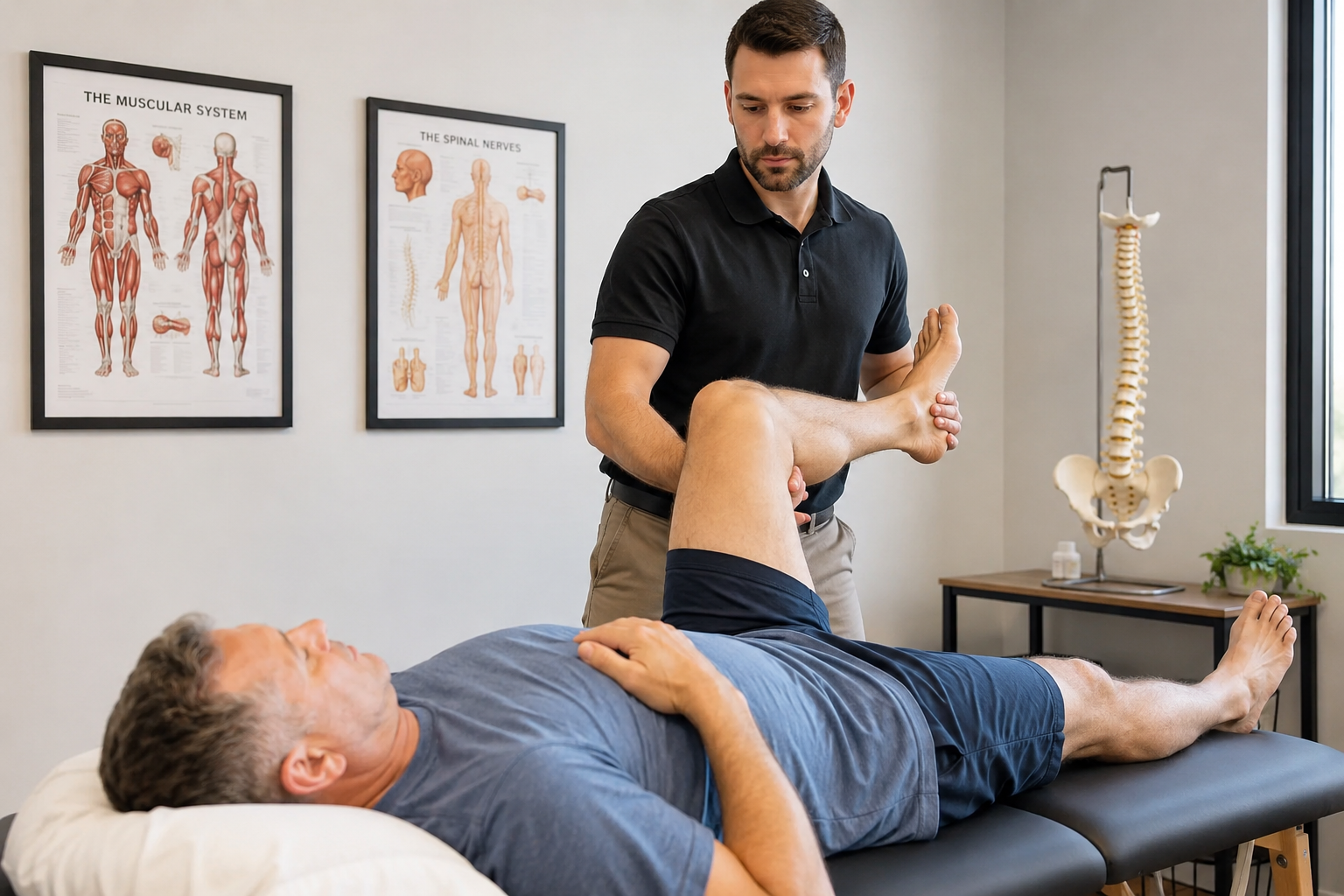
Leg pain can be confusing, especially when the discomfort seems far away from where the problem actually begins. You may feel aching in your hip, burning in your thigh, tingling in your calf, or even sharp pain traveling toward your foot. It is natural to assume that the problem must be somewhere in the leg itself.
But sometimes, the source of leg pain is actually in the lower back.
At Complete Performance Chiropractic in St. Charles, Missouri, we regularly see patients experiencing symptoms that may be connected to irritation or compression of nerves in the lumbar spine. Conditions such as sciatica and lumbar radiculopathy can cause pain, numbness, tingling, weakness, or other unusual sensations that travel from the lower back into the buttocks and legs.
Understanding where your symptoms originate is an important part of developing an appropriate treatment plan. Instead of focusing only on the location where pain is felt, our approach looks at the spine, surrounding tissues, movement patterns, and potential sources of nerve irritation.
Why Can a Problem in Your Back Cause Leg Pain?
Your lower back contains the lumbar portion of the spinal column, which protects and supports important nerves. These nerves travel from the spinal cord through openings between the vertebrae and eventually extend into the lower body.
When a nerve becomes irritated or compressed, the resulting symptoms may not remain in the back.
This is why a person can have relatively mild lower back discomfort but significant pain traveling down one leg.
Several conditions can contribute to nerve irritation, including:
Bulging or herniated discs
Degenerative disc changes
Spinal arthritis
Foraminal narrowing
Spinal stenosis
Changes in spinal alignment or movement
Inflammation surrounding affected structures
The exact cause varies from person to person. That is why simply treating the painful area of the leg may not address the underlying contributor.
What Is Sciatica?
Sciatica describes symptoms associated with irritation or compression of the sciatic nerve or its contributing nerve roots. According to the Mayo Clinic, the sciatic nerve is formed from nerves originating in the lower spine and travels through the buttocks and down the leg.
Sciatica can produce symptoms on one side of the body, although patterns can vary.
Common symptoms include:
Pain traveling from the lower back or buttock into the leg
Burning or electric-like sensations
Tingling or pins-and-needles
Numbness
Leg discomfort that worsens with certain positions
Weakness in some cases
Some people describe sciatica as a sharp, shooting pain. Others experience a dull ache or persistent burning sensation.
The important point is that sciatica is a description of a symptom pattern rather than a single underlying diagnosis. Determining what may be irritating the nerve can help guide appropriate care.
Sciatica vs. Lumbar Radiculopathy: What’s the Difference?
The terms sciatica and lumbar radiculopathy are sometimes used interchangeably, but they are not exactly the same.
Lumbar radiculopathy refers to a problem involving one or more nerve roots in the lower spine. Compression or irritation of a nerve root can cause symptoms that travel along the path of that nerve into the buttock or leg.
Sciatica generally refers specifically to symptoms involving the sciatic nerve pathway.
For example, a disc problem in the lumbar spine may irritate a nerve root. That irritation can produce pain or altered sensation that travels down the leg. Depending on the affected nerve, symptoms may follow a particular pattern.
This distinction matters because identifying the likely source of symptoms can help determine which conservative treatment options may be appropriate.
What Can Cause Nerve Compression in the Lower Back?
Nerve compression can happen for several reasons, particularly as the spine changes over time.
Bulging or Herniated Discs
The discs between your vertebrae provide cushioning and help the spine handle movement. When a disc bulges or herniates, it can sometimes affect nearby nerve structures.
Not every bulging or herniated disc causes symptoms. Some people have disc changes without experiencing pain at all.
When a disc does contribute to nerve irritation, however, symptoms may extend from the lower back into the buttocks or leg.
Degenerative Disc Changes
As we age, spinal discs can undergo structural changes. These changes may alter the mechanics of the spine and, in some cases, contribute to reduced space around nerve structures.
As noted by the Cleveland Clinic, degenerative disc disease does not automatically mean that someone will experience severe pain or require surgery. Symptoms and imaging findings do not always correspond perfectly.
A thorough evaluation can help place those findings into context.
Spinal Stenosis
Spinal stenosis occurs when spaces within or around the spinal canal become narrowed. In the lumbar spine, this narrowing may affect nerves traveling toward the legs.
Some people notice symptoms when standing or walking for extended periods. Sitting or changing position may alter the discomfort.
Foraminal Narrowing
Nerves exit the spine through openings called foramina. Changes involving discs, joints, or other spinal structures can reduce available space around these nerve pathways.
When a nerve becomes irritated within this area, pain, numbness, tingling, or weakness may develop along the nerve’s pathway.
Why Finding the Root Cause Matters
When leg pain is connected to the spine, treating the leg alone may not be enough.
At Complete Performance Chiropractic, our focus is on understanding the bigger picture. We consider your symptoms, medical history, movement, physical findings, and other relevant factors when determining what may be contributing to your discomfort.
For selected patients, imaging may also be relevant, particularly when considering certain forms of spinal decompression. Our FAQ explains that imaging is generally performed before spinal decompression to help determine whether the treatment is appropriate.
The goal is not simply to chase symptoms. It is to understand the structures involved and determine whether conservative care may be appropriate.
How Conservative Spinal Care May Help
Not every person with sciatica or lumbar radiculopathy needs the same treatment. An individualized approach is important because the underlying causes and severity of symptoms can differ significantly.
Depending on the evaluation, conservative care may include chiropractic treatment, spinal decompression, supportive therapies, and movement or rehabilitation strategies.
Chiropractic Care
Our chiropractic services include manual and instrument-assisted adjustments, with techniques selected according to individual needs and tolerances.
The purpose of appropriate chiropractic care may include supporting spinal movement, improving joint function, and reducing mechanical stress that may contribute to discomfort.
Treatment is not identical for every patient. The technique and amount of force can be adapted based on the person’s condition and response to care.
Non-Surgical Spinal Decompression
Spinal decompression is particularly relevant when back and leg symptoms may be associated with disc or nerve pressure.
Our clinic uses motorized traction as part of spinal decompression therapy. The treatment gently stretches the spine with the goal of reducing stress on affected spinal structures.
For appropriately selected patients, this approach may help reduce back or leg pain and support improved mobility. It is a non-surgical option and may be considered as part of a broader conservative care plan.
Class IV Laser Therapy
Inflammation and irritated tissues can contribute to discomfort around the spine and nerve pathways. Our Class IV Laser Therapy uses specific red and near-infrared wavelengths.
At Complete Performance Chiropractic, laser therapy is used for conditions that can include sciatic pain, back pain, degenerative discs and joints, and other musculoskeletal concerns.
The therapy may help support circulation, reduce inflammation, and promote tissue repair. Whether it is appropriate depends on the individual patient’s condition and treatment goals.
Everyday Signs Your Leg Pain May Be Coming From Your Spine
Certain patterns can make a spinal source more likely.
Pay attention if your leg pain:
Begins in the lower back or buttock and travels downward
Follows a relatively consistent path through the leg
Includes tingling, numbness, or burning
Changes depending on your spinal position
Becomes worse with prolonged sitting, standing, or walking
Occurs together with lower back discomfort
Is accompanied by changes in leg strength
These signs do not automatically prove that your spine is responsible. Other conditions, as outlined by Johns Hopkins Medicine, can also cause leg pain. A proper evaluation is important before assuming that sciatica, nerve compression, or lumbar radiculopathy is the cause. You can read more on our blog for additional insights.
When Should You Have Leg Pain Evaluated?
Persistent or recurring leg pain deserves attention, particularly when it interferes with walking, exercising, sleeping, working, or spending time with family.
It is also important to seek prompt medical evaluation for significant or progressive weakness, severe or rapidly worsening symptoms, or changes involving bladder or bowel control. These symptoms can indicate a serious neurological problem requiring urgent medical attention.
For less urgent but persistent symptoms, a professional evaluation can help determine whether the discomfort may be associated with the lumbar spine or another structure.
Frequently Asked Questions
1. Can lower back problems really cause leg pain?
Yes. Irritation or compression of nerves originating in the lumbar spine can cause symptoms that travel into the buttocks and legs. Sciatica and lumbar radiculopathy are common examples.
2. Does sciatica always involve severe back pain?
No. Some people experience substantial leg symptoms while having relatively little lower back pain. The pattern depends on which nerves or structures are involved.
3. Is lumbar radiculopathy the same as sciatica?
They are related but not identical. Lumbar radiculopathy describes irritation or compression of a nerve root in the lower spine, while sciatica generally refers to symptoms affecting the sciatic nerve pathway.
4. Can a bulging disc cause leg pain?
A bulging disc can sometimes contribute to nerve irritation when it affects nearby nerve structures. However, many people have disc bulges without symptoms, so an evaluation is important.
5. Can spinal decompression help with sciatica?
Spinal decompression may be appropriate for selected patients experiencing back or leg symptoms associated with spinal structures. Our team evaluates the individual condition and may use imaging when appropriate before recommending decompression.
6. Do I need surgery for nerve compression?
Not necessarily. The appropriate treatment depends on the cause, severity, neurological findings, and overall health. Conservative care may be an option for many patients, while some situations require referral for additional medical evaluation.
7. What should I do if my leg pain keeps coming back?
Recurring symptoms should not simply be ignored. An evaluation can help determine whether the pain may be coming from the lumbar spine, a joint, muscle, nerve, or another source and whether conservative care may be appropriate.
Conclusion
Leg pain does not always begin in the leg.
When discomfort travels from the lower back or buttocks into the thigh, calf, or foot, the lumbar spine may be part of the picture. Sciatica, lumbar radiculopathy, bulging discs, degenerative changes, spinal stenosis, and other conditions can affect the nerves that travel into the lower extremities.
Understanding the potential source of your symptoms is the first step toward making informed decisions about care.
At Complete Performance Chiropractic, our approach centers on individualized, conservative spinal care. Chiropractic treatment, non-surgical spinal decompression, Class IV Laser Therapy, and other supportive services may be considered when appropriate for the patient’s specific needs.
The goal is to help patients better understand their condition while supporting mobility, function, and long-term spinal health without automatically jumping to invasive treatment.
If persistent neck, back, or leg pain is affecting your daily life, consider contacting us to schedule a consultation with Complete Performance Chiropractic. Our team can evaluate your symptoms and help determine whether your leg pain may be connected to your spine and what conservative options may be appropriate.
Complete Performance Chiropractic
📍 3920 S Old Highway 94, Suite 33, St. Charles, MO 63304, United States
📞 (636) 925-1919
🌐 drleitman.com
Our goal is to help you understand the root of your pain and make informed decisions about your spinal health.