
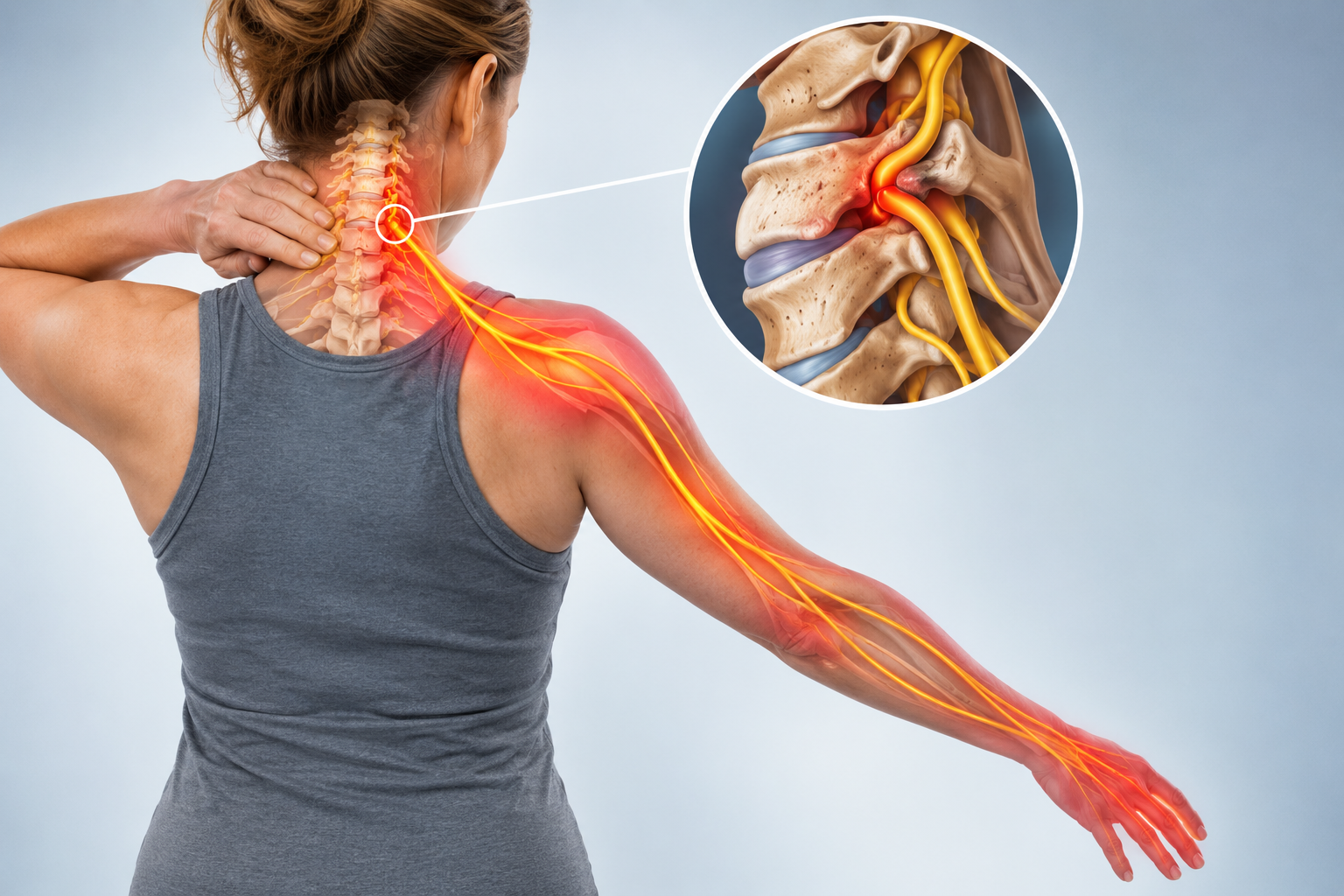
Neck pain is common, especially as we get older, but pain that travels from your neck into your shoulder, arm, hand, or fingers deserves closer attention. If you have noticed burning, tingling, numbness, weakness, or an electric-like sensation traveling down your arm, the source may not be your shoulder or arm at all. In some cases, these symptoms can be related to a problem in the cervical spine.
One condition that can cause this pattern is cervical radiculopathy, which occurs when a nerve root in the neck becomes irritated or compressed. Disc degeneration, a bulging or herniated disc, arthritis, or narrowing around the spinal nerves can contribute to this type of nerve compression.
At Complete Performance Chiropractic, we believe understanding where symptoms originate is an important part of developing an appropriate care plan. Our approach focuses on evaluating the spine, identifying contributing factors, and considering conservative treatment options that may help reduce discomfort and improve movement and daily function.
What Is Cervical Radiculopathy?
Cervical radiculopathy refers to irritation or compression of a nerve root as it exits the cervical spine, or the neck portion of your spine. The cervical spine contains seven vertebrae, with discs between many of them that help absorb forces and allow the neck to move.
Nerves leaving the cervical spine travel toward the shoulders, arms, hands, and fingers. When one of these nerve roots becomes irritated, symptoms may extend well beyond the neck.
This is why someone can have relatively mild neck pain but significant symptoms in an arm or hand.
Depending on which nerve is affected, cervical radiculopathy may cause:
Neck pain or stiffness
Pain traveling into the shoulder or arm
Tingling or pins-and-needles sensations
Numbness in the arm or hand
Burning or sharp pain
An electric-like sensation
Weakness in certain muscles
Symptoms that worsen with particular neck positions
The exact symptoms depend on the location and severity of the nerve irritation.
Why Can a Nerve in the Neck Cause Arm Pain?
The nervous system creates a communication pathway between the brain, spinal cord, and the rest of the body. Nerve roots exiting the cervical spine supply different regions of the upper body.
When a nerve root becomes compressed or irritated, the brain may interpret those signals as pain, tingling, or numbness along the nerve’s pathway.
This phenomenon is sometimes called radiating or radicular pain.
For example, a person may feel discomfort beginning near the base of the neck and continuing through the shoulder and down the arm. Another person may primarily notice tingling in the hand or fingers.
The location of the symptoms can provide useful information, but symptoms alone do not always identify the exact cause. That is why a thorough evaluation is important.
What Causes Cervical Nerve Compression?
Several conditions can contribute to cervical nerve compression. In adults over 40, age-related changes in the spine can become increasingly relevant.
Degenerative Disc Changes
The discs between the vertebrae can gradually change with age. They may lose some of their normal height or flexibility, potentially changing the space available around nearby structures.
Degenerative disc disease does not automatically mean a person will experience pain. However, when degenerative changes contribute to irritation or narrowing around a nerve, symptoms may develop.
Bulging or Herniated Discs
A disc can bulge or herniate and potentially place pressure on a nearby nerve root.
A bulging disc does not always produce symptoms, and imaging findings do not necessarily explain every person’s pain. The important question is whether the structural findings and clinical symptoms appear to correspond.
Arthritis and Bone Changes
Arthritis in the cervical spine can contribute to changes in the joints and surrounding structures. Over time, these changes may reduce the space available for nerve roots.
This can contribute to foraminal narrowing and, in some cases, cervical nerve compression.
Spinal Stenosis
Cervical spinal stenosis occurs when the spaces within or around the spinal canal become narrower. Depending on where narrowing occurs, nerves may have less room.
Because several conditions can produce similar symptoms, identifying the underlying contributors is an important part of responsible care.
What Does Nerve Compression Feel Like?
Nerve-related symptoms often feel different from ordinary muscle soreness.
Someone with muscular neck tension may experience aching, tightness, or tenderness concentrated around the neck and upper shoulders. Nerve irritation may create sensations that travel farther away from the original area.
You might notice:
Pain that travels: Discomfort may move from the neck into the shoulder, arm, wrist, or hand.
Tingling: Some people describe this as pins and needles or a sensation similar to an arm falling asleep.
Numbness: Parts of the arm or hand may feel less sensitive than normal.
Burning or electrical sensations: Nerve-related pain can sometimes feel sharp, hot, burning, or shock-like.
Weakness: Some people notice difficulty gripping objects or performing certain movements.
These symptoms should not automatically be assumed to be cervical radiculopathy. Other conditions affecting the shoulder, peripheral nerves, or other structures can produce overlapping symptoms.
When Neck Pain Travels Into Your Arm, Don’t Ignore the Pattern
Persistent radiating symptoms are worth discussing with a qualified healthcare professional, particularly when they interfere with normal activities.
If reaching overhead, turning your head, working at a computer, driving, sleeping, exercising, or carrying groceries consistently aggravates your symptoms, it may be time to investigate what is contributing to the problem.
At Complete Performance Chiropractic, our evaluation process is designed to look beyond the location of pain. We consider the history of your symptoms, movement, physical findings, and other relevant information to help determine what may be contributing to your condition.
When appropriate, imaging or other diagnostic information may also be considered. Our goal is to create an individualized plan rather than assuming that every person with neck and arm pain needs the same treatment.
How Conservative Spinal Care May Help
Not every person with cervical radiculopathy requires surgery. Treatment depends on the underlying condition, severity of symptoms, neurological findings, and individual circumstances.
Conservative spinal care may include approaches designed to improve joint mechanics, reduce irritation, support mobility, and address contributing soft-tissue or movement problems.
Chiropractic Care
Chiropractic care may be appropriate for selected patients with neck pain and certain mechanical problems affecting the cervical spine.
Our techniques are individualized rather than applying the same adjustment to every patient. The amount and type of care can be adapted according to a person’s condition, comfort, and specific needs. Our clinic uses several chiropractic techniques, including manual and instrument-assisted approaches.
The goal is not simply to chase symptoms. We look at how the spine and surrounding structures are functioning and how that may relate to the patient’s complaints.
Spinal Decompression
For appropriately selected patients, non-surgical spinal decompression may be considered when disc-related or nerve-related symptoms are present.
Our website describes spinal decompression as motorized traction that gently stretches the spine and may help relieve certain neck or back symptoms. The clinic notes that imaging is generally performed before this treatment to help determine whether a patient may be an appropriate candidate.
Spinal decompression is not appropriate for everyone, which is why an individualized evaluation matters.
Class IV Laser Therapy
Class IV laser therapy is another non-invasive service available at Complete Performance Chiropractic. The clinic describes its use for conditions involving neck and back pain, arthritis, degenerative discs and joints, and other musculoskeletal problems.
Laser therapy uses specific red and near-infrared wavelengths and is intended to support processes such as circulation, tissue repair, and management of inflammation and pain. Whether it belongs in a particular care plan depends on the patient’s condition and treatment goals.
Everyday Habits That May Affect Neck Symptoms
Treatment is only one part of caring for your spine. Everyday habits can also influence how much stress is placed on the neck.
If you spend hours looking down at a phone, working at a computer, or sitting in one position, consider taking regular movement breaks.
Other helpful habits may include:
Adjusting your computer monitor so you are not constantly looking downward
Avoiding prolonged static positions
Using a supportive sleeping position
Taking movement breaks during long drives
Following individualized mobility or exercise recommendations
Paying attention to activities that consistently aggravate symptoms
These strategies are not guaranteed to eliminate cervical radiculopathy, but they can be part of a broader approach to maintaining mobility and supporting spinal health.
When Should You Seek Professional Evaluation?
Neck pain that lasts for several days may sometimes improve with conservative self-care. However, symptoms that repeatedly travel into the arm deserve additional attention.
Consider scheduling an evaluation if you experience persistent:
Arm pain associated with neck movement
Numbness or tingling
Burning or electric-like sensations
Hand or arm weakness
Neck pain that repeatedly returns
Symptoms that interfere with sleep or daily activities
Seek prompt medical attention for significant or rapidly worsening weakness, severe neurological symptoms, loss of coordination, problems with walking, or changes in bowel or bladder control.
Frequently Asked Questions
1. Can a pinched nerve in the neck cause arm pain?
Yes. Irritation or compression of a cervical nerve root can cause pain, tingling, numbness, or weakness that travels from the neck into the shoulder, arm, or hand.
2. Is cervical radiculopathy the same as a pinched nerve?
The terms are related, but cervical radiculopathy specifically describes symptoms caused by irritation or compression of a nerve root in the cervical spine. “Pinched nerve” is a more general phrase commonly used to describe nerve compression.
3. Can a herniated disc cause neck and arm pain?
It can. A cervical disc herniation may irritate or compress a nearby nerve root, potentially producing radiating symptoms into the shoulder or arm.
4. Does cervical radiculopathy always require surgery?
No. Treatment depends on the cause, severity, neurological findings, and individual circumstances. Conservative approaches may be appropriate for selected patients, while more serious or persistent cases may require evaluation by other medical specialists.
5. Can chiropractic care help with cervical radiculopathy?
Chiropractic care may be appropriate for some people with neck-related pain and mechanical problems. At Complete Performance Chiropractic, treatment is individualized according to the patient’s condition, symptoms, and tolerance.
6. What is spinal decompression used for?
Non-surgical spinal decompression uses controlled traction to gently stretch the spine. At Complete Performance Chiropractic, it may be considered for selected patients with radiating neck or back symptoms after appropriate evaluation.
7. Should I ignore arm tingling if my neck doesn’t hurt much?
No. Significant arm tingling, numbness, or weakness can have several possible causes, including nerve-related problems. A professional evaluation can help determine where the symptoms may be coming from.
Conclusion
Neck pain that travels into your arm is more than an uncomfortable nuisance. The pattern of symptoms can sometimes indicate irritation or compression of a cervical nerve, particularly when pain is accompanied by tingling, numbness, burning sensations, or weakness.
Cervical radiculopathy can be associated with conditions such as degenerative disc changes, bulging or herniated discs, arthritis, and narrowing around the nerves. Understanding the potential source of the symptoms is an important first step toward choosing an appropriate treatment strategy.
At Complete Performance Chiropractic, our focus is on comprehensive, individualized spinal care. Depending on the findings of an evaluation, conservative options such as chiropractic care, spinal decompression, and Class IV laser therapy may be considered as part of a personalized plan.
Our goal is to help patients better understand their spine, manage pain conservatively when appropriate, maintain mobility, and continue participating in the activities that matter to them.
If neck pain is traveling into your shoulder, arm, or hand, don’t assume it is simply a muscle problem. Understanding whether nerve compression or another spinal condition may be contributing to your symptoms can help you make informed decisions about your care.
If you are experiencing persistent neck pain, arm pain, numbness, tingling, or other symptoms that may be related to the cervical spine, contact us to schedule a consultation. Our team can evaluate your symptoms and discuss whether conservative spinal care may be appropriate for your individual situation.
Complete Performance Chiropractic
📍 3920 S Old Highway 94, Suite 33
Saint Charles, MO 63304, United States
📞 (636) 925-1919
🌐 drleitman.com