
The Difference Between “True” Spinal Decompression and Traction Tables
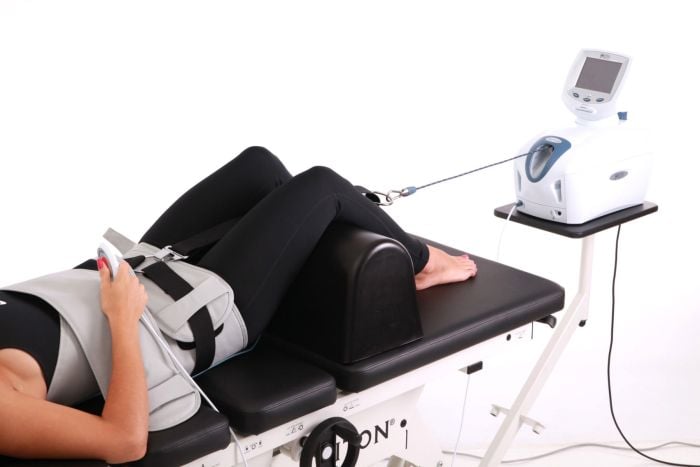
Patients researching back pain often run into two different terms, spinal decompression and spinal traction. Some websites describe them as completely different treatments. Others use the terms as though they mean the same thing.
The honest answer sits in the middle. Nonsurgical spinal decompression uses traction. The meaningful differences usually involve the equipment, control system, patient positioning, treatment settings, and clinical decision-making.
What Is Basic Spinal Traction?
Traction applies a pulling force to the spine. The goal is to temporarily reduce loading on spinal structures and create more space between vertebrae. Traction might be manual, gravity-based, static, intermittent, or motorized.
A basic traction table often uses a steady or repeating force across a broad area. The provider selects the force and treatment time, then monitors the patient’s comfort and response.
What Do Clinics Mean by “True Spinal Decompression”?
The phrase “true spinal decompression” is a marketing term, not a universal medical category. Clinics often use the phrase to describe a more advanced motorized traction system with greater control over how force is applied.
Advanced decompression systems often allow adjustments to:
- The amount of force
- The angle of pull
- The treatment cycle
- The increase and decrease in force
- Patient positioning
- Lumbar or cervical treatment selection
- Settings based on patient comfort and response
The Table Does Not Replace the Examination
A more advanced machine does not guarantee a better result. The provider still needs to identify the likely source of pain, review health history, look for contraindications, and select a reasonable treatment plan.
A muscle strain needs a different approach from a disc injury, fracture, infection, spinal instability, or severe nerve compression. No table should replace proper evaluation or necessary medical care.
What Does the Research Say?
Research on spinal traction and nonsurgical decompression shows mixed results. A 2024 study found both motorized traction and spinal decompression improved outcomes when added to conventional treatment for people with lumbar disc problems. The two traction-based approaches produced similar results.
Other systematic reviews report short-term improvement for some patients with low back pain and radiating leg pain. Broader reviews have found little benefit when traction is applied to large, mixed groups of patients with nonspecific low back pain.
The takeaway is simple. Patient selection matters. Treatment should match the condition, symptoms, goals, and response.
Questions to Ask Before Starting Treatment
- What is the likely source of my pain?
- Why does this treatment fit my examination findings?
- How will the force and angle be selected?
- How will progress be measured?
- What happens if my symptoms worsen?
- When would imaging or a medical referral be appropriate?
Spinal Decompression in St. Charles, MO
Complete Performance Chiropractic offers nonsurgical spinal decompression for selected patients with back or leg pain. Dr. Eric Leitman reviews your symptoms, health history, examination findings, and available imaging before recommending treatment.
Call 636-925-1919 to request a spinal decompression consultation.
Complete Performance Chiropractic
3920 S. Old Highway 94, Suite 33
St. Charles, Missouri 63304