
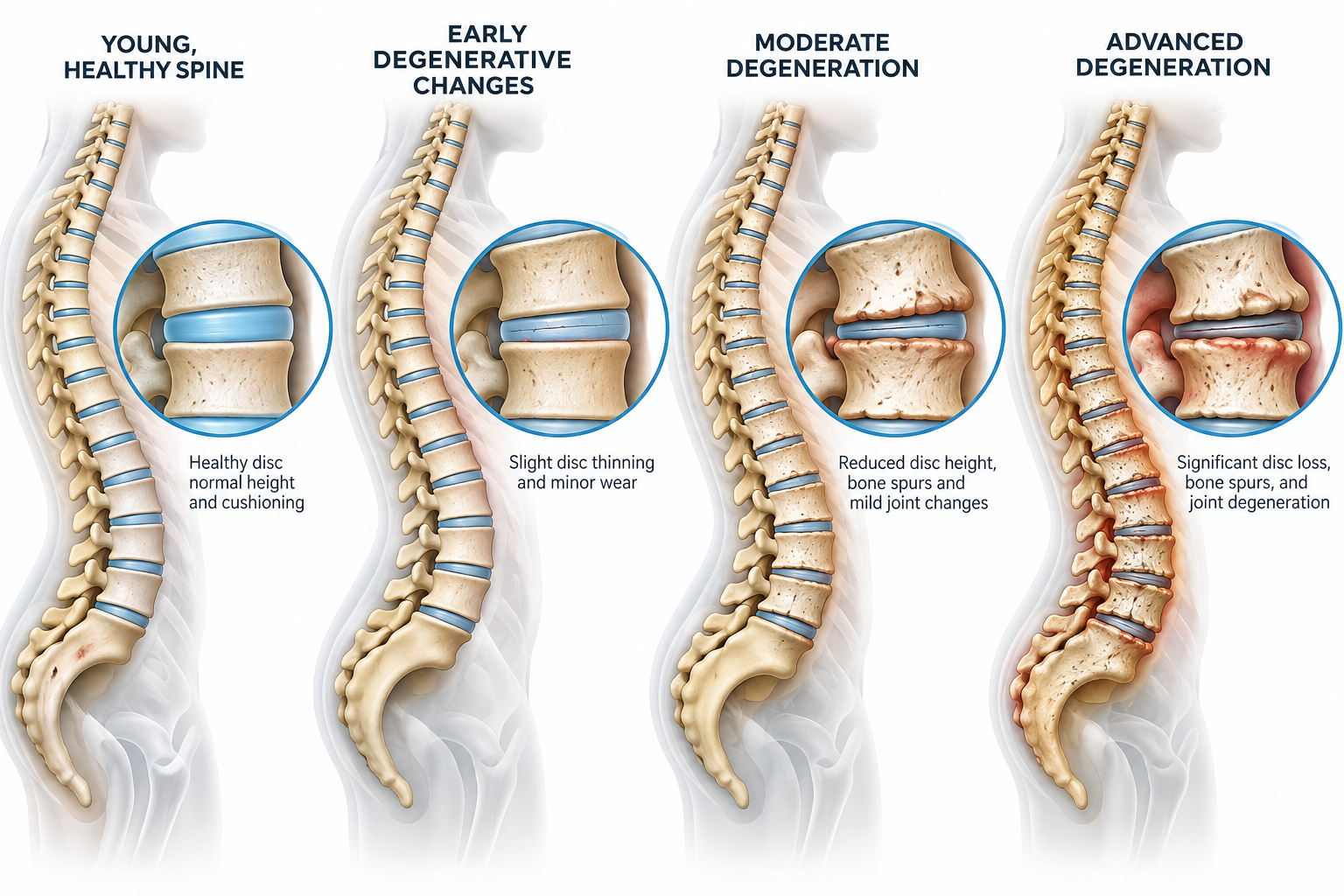
Aging affects every part of the body, and the spine is no exception. As the years pass, the discs, joints, bones, ligaments, and muscles that support your spine naturally experience changes. Some of these changes are a normal part of getting older and may never cause noticeable symptoms. For others, degeneration can contribute to stiffness, reduced mobility, inflammation, back pain, neck pain, or symptoms that travel into the arms or legs.
At Complete Performance Chiropractic, we often remind patients that getting older does not automatically mean accepting chronic pain or giving up the activities they enjoy. Understanding how the spine changes with age is an important first step toward making informed decisions about spinal health.
Conditions such as Degenerative Disc Disease (DDD), Degenerative Joint Disease (DJD), spinal arthritis, bulging discs, spinal stenosis, and nerve compression can become more common with age. However, the presence of degenerative changes on an X-ray or MRI does not always mean that severe pain is inevitable.
Our approach to advanced spinal care begins by looking at the individual—not simply an imaging report. We consider symptoms, movement, spinal function, lifestyle, and personal goals when determining what type of conservative care may be appropriate.
How Does the Spine Change as You Age?
Your spine is designed to provide both stability and movement. It consists of vertebrae, discs, facet joints, ligaments, muscles, and nerves that work together every day.
Over decades of walking, lifting, sitting, bending, exercising, working, and simply moving through life, these structures are exposed to repeated stress. The body continually adapts, repairs, and remodels itself. Eventually, certain age-related changes may become visible.
These changes can include:
Reduced flexibility of spinal discs
Loss of disc height
Changes in the facet joints
Reduced range of motion
Development of bone spurs
Thickening of certain spinal ligaments
Changes in spinal alignment
Increased stiffness in surrounding muscles and joints
Not everyone develops symptoms from these changes. In fact, many adults have some degree of spinal degeneration without experiencing significant pain.
That distinction is important. Aging and degeneration are not automatically the same thing as disability.
What Happens to Spinal Discs With Age?
The discs between your vertebrae act somewhat like cushions. They help absorb forces while allowing the spine to bend, rotate, and move.
As we age, discs can gradually lose water content and become less flexible. Their ability to absorb shock may change, and the spaces between vertebrae can become narrower.
These age-related changes are commonly described as Degenerative Disc Disease, although the term can sound more alarming than the condition actually is. Disc degeneration is often part of the normal aging process rather than a traditional disease.
A degenerating disc may also become more vulnerable to bulging or herniation. In some cases, changes around the disc can contribute to irritation or compression of nearby nerves.
This may produce symptoms such as:
Lower back pain
Neck pain
Stiffness
Tingling
Numbness
Pain traveling into an arm or leg
Weakness in an affected area
The important point is that symptoms vary considerably from person to person.
How Aging Affects the Spinal Joints
The discs are not the only structures affected by aging. The facet joints located toward the back of the spine can also experience gradual wear.
These small joints help guide spinal movement and provide stability. Over time, cartilage within the joints can deteriorate, potentially contributing to Degenerative Joint Disease or spinal arthritis.
Spinal arthritis may cause stiffness and discomfort that becomes more noticeable after periods of inactivity. Some people notice symptoms when getting out of bed in the morning, standing after sitting for a long time, or rotating the neck or lower back.
Bone spurs may also develop around degenerating joints. These growths are the body’s response to changes in joint stress and stability. While bone spurs themselves may not always cause symptoms, they can sometimes contribute to narrowing around nerves.
Why Spinal Stenosis Can Become More Common With Age
Another degenerative change that may occur over time is spinal stenosis.
Spinal stenosis refers to narrowing within areas of the spinal canal or the openings through which spinal nerves travel. Disc changes, bone spurs, and thickened ligaments can all contribute to this narrowing.
When nerves become irritated or compressed, symptoms may include pain, numbness, tingling, or weakness.
Lumbar spinal stenosis may cause discomfort that travels into the buttocks or legs, particularly during standing or walking. Cervical changes can affect the neck and potentially contribute to symptoms involving the shoulders, arms, or hands.
Persistent or worsening neurological symptoms should always receive appropriate medical evaluation.
Does Spinal Degeneration Always Cause Pain?
No. This is one of the most important things to understand about aging and spinal health.
It is possible to have degenerative changes on an X-ray or MRI without having significant pain. Conversely, someone may experience considerable discomfort even when imaging findings appear relatively mild.
This is why we do not believe spinal care should focus exclusively on what appears on a scan.
At Complete Performance Chiropractic, our evaluation considers the complete picture. Symptoms, physical findings, movement patterns, neurological signs, daily activities, and functional limitations can all provide important information. Imaging may also be considered when appropriate.
The goal is to understand what may be contributing to your symptoms and how those symptoms are affecting your ability to live normally.
How Aging Can Affect Everyday Movement
Degenerative spinal changes can sometimes become noticeable through everyday activities before a person thinks of the problem as a “spine condition.”
You might notice that:
Getting out of a chair takes longer.
You avoid bending forward.
Turning your head while driving feels restricted.
Walking for long periods causes discomfort.
Standing at the kitchen counter becomes tiring.
Gardening or household chores leave you sore.
Playing golf or exercising feels more difficult.
You have stopped doing activities you once enjoyed.
These changes can gradually affect confidence and activity levels.
Less movement can then lead to reduced strength, flexibility, and conditioning, creating a cycle in which the body becomes increasingly sensitive to physical demands.
That is why maintaining appropriate movement is an important part of long-term spinal health.
Readers in the Ahwatukee area who want to learn more about individualized chiropractic care for mobility and everyday function can explore Boardman Family Chiropractic.
What Can You Do to Support Your Spine as You Age?
Aging cannot be stopped, but there are practical ways to support spinal function.
Stay Physically Active
Regular movement helps maintain strength, mobility, balance, and cardiovascular health. Walking, appropriate strengthening exercises, mobility work, and other activities can be valuable depending on your individual health and physical abilities.
If you already have significant spinal pain, start gradually and consider professional guidance before substantially changing your exercise routine.
Pay Attention to Posture and Movement
Posture is only one part of spinal health, but spending hours in one position can contribute to stiffness and discomfort.
Changing positions regularly, taking movement breaks, and learning how to lift or bend with better mechanics may help reduce unnecessary stress.
Maintain Strength and Flexibility
Strong muscles around the trunk, hips, and shoulders can help support everyday movement. Flexibility is also important because restricted mobility can cause the body to compensate during normal activities.
A Functional Movement Assessment can help identify limitations in mobility, balance, strength, and movement patterns. This information may help guide an individualized care or exercise plan.
How Conservative Spinal Care May Help
Not every age-related spinal condition requires surgery. Depending on the individual’s diagnosis and symptoms, conservative care may be an appropriate starting point.
At Complete Performance Chiropractic, chiropractic care may be used to support spinal and joint mobility and address mechanical contributors to discomfort. Our techniques are individualized rather than applying the same adjustment to every patient.
For selected patients, Class IV Laser Therapy may also be incorporated into a treatment plan. This non-invasive therapy uses therapeutic wavelengths of light and may help support circulation, tissue repair, and the body’s response to inflammation. Our clinic offers Class IV Laser Therapy for conditions including back and neck pain, sciatic pain, arthritis, and degenerative disc or joint conditions.
Axial Spinal Decompression may be considered for certain patients with disc-related problems or nerve compression. The therapy uses controlled traction intended to reduce stress on affected spinal structures. Proper evaluation is important before determining whether decompression is appropriate.
The objective is not simply to chase pain. Instead, our approach focuses on understanding the factors contributing to discomfort and helping patients maintain mobility and function whenever possible.
When Should You Have Your Spine Evaluated?
Occasional stiffness after a long day is different from persistent or progressive symptoms.
Consider seeking professional evaluation if you experience ongoing back or neck pain, recurring episodes of sciatica, numbness, tingling, weakness, reduced mobility, or pain that consistently interferes with work, exercise, sleep, or everyday activities.
Symptoms that are severe, rapidly worsening, or accompanied by significant neurological changes require prompt medical attention.
An evaluation can help determine whether your symptoms may be related to degenerative disc changes, arthritis, nerve irritation, spinal stenosis, muscular problems, or another condition.
Frequently Asked Questions
Is spinal degeneration a normal part of aging?
Some degree of age-related change in the discs and spinal joints is common. However, degeneration does not automatically mean you will develop severe pain or loss of function.
Does Degenerative Disc Disease mean my spine is permanently damaged?
Degenerative Disc Disease describes changes that occur within spinal discs over time. The diagnosis does not automatically mean that severe symptoms or disability will occur. Treatment decisions should be based on your symptoms, examination, functional limitations, and overall health.
Can exercise help an aging spine?
Appropriate physical activity can support strength, mobility, balance, and overall function. The ideal exercise program depends on your condition, fitness level, and limitations.
Can chiropractic care help with age-related back pain?
For appropriately selected patients, chiropractic care may help improve spinal and joint mobility and support conservative management of certain musculoskeletal conditions. Treatment should be individualized based on the patient’s needs.
Is spinal decompression appropriate for everyone?
No. Spinal decompression is not appropriate for every patient or every spinal condition. A thorough evaluation is important before determining whether this therapy is suitable.
Can laser therapy be used for degenerative conditions?
Class IV Laser Therapy may be incorporated into selected treatment plans for conditions involving pain and inflammation, including certain degenerative disc and joint conditions. It is not a universal treatment, and recommendations depend on individual circumstances.
Do I need surgery because an MRI shows degeneration?
Not necessarily. Imaging findings alone do not determine whether surgery is needed. Many people have degenerative changes without significant symptoms. A qualified healthcare professional can help determine the appropriate next step based on the complete clinical picture.
Conclusion
Your spine changes as you age. Discs can lose hydration and flexibility, joints can develop degenerative changes, bone spurs may form, and spaces around spinal nerves can gradually become narrower.
These changes are common, but they do not automatically mean that chronic pain or reduced independence is unavoidable.
The most important step is understanding what is happening in your individual spine and how those changes relate to your symptoms and movement. With appropriate evaluation and conservative care when suitable, many people can continue working toward better mobility, strength, and daily function.
At Complete Performance Chiropractic, our philosophy centers on comprehensive spinal care rather than treating an imaging finding in isolation. Through individualized chiropractic care, Functional Movement Assessment, Class IV Laser Therapy, Axial Spinal Decompression, and other appropriate approaches, we work to understand the factors contributing to discomfort and develop care around each patient’s needs and goals.
If persistent neck or back pain is making it harder to walk, exercise, work, travel, sleep, or enjoy the activities you value, consider having your spine evaluated.
At Complete Performance Chiropractic, we provide individualized, conservative spinal care for patients looking for options that prioritize mobility and function. Contact our team to schedule a consultation and learn whether an advanced spinal care approach may be appropriate for you.
Complete Performance Chiropractic
📍 Address: 3920 S Old Highway 94, Suite 33, Saint Charles, MO 63304, United States
📞 Phone: (636) 925-1919
🌐 Website: https://drleitman.com