
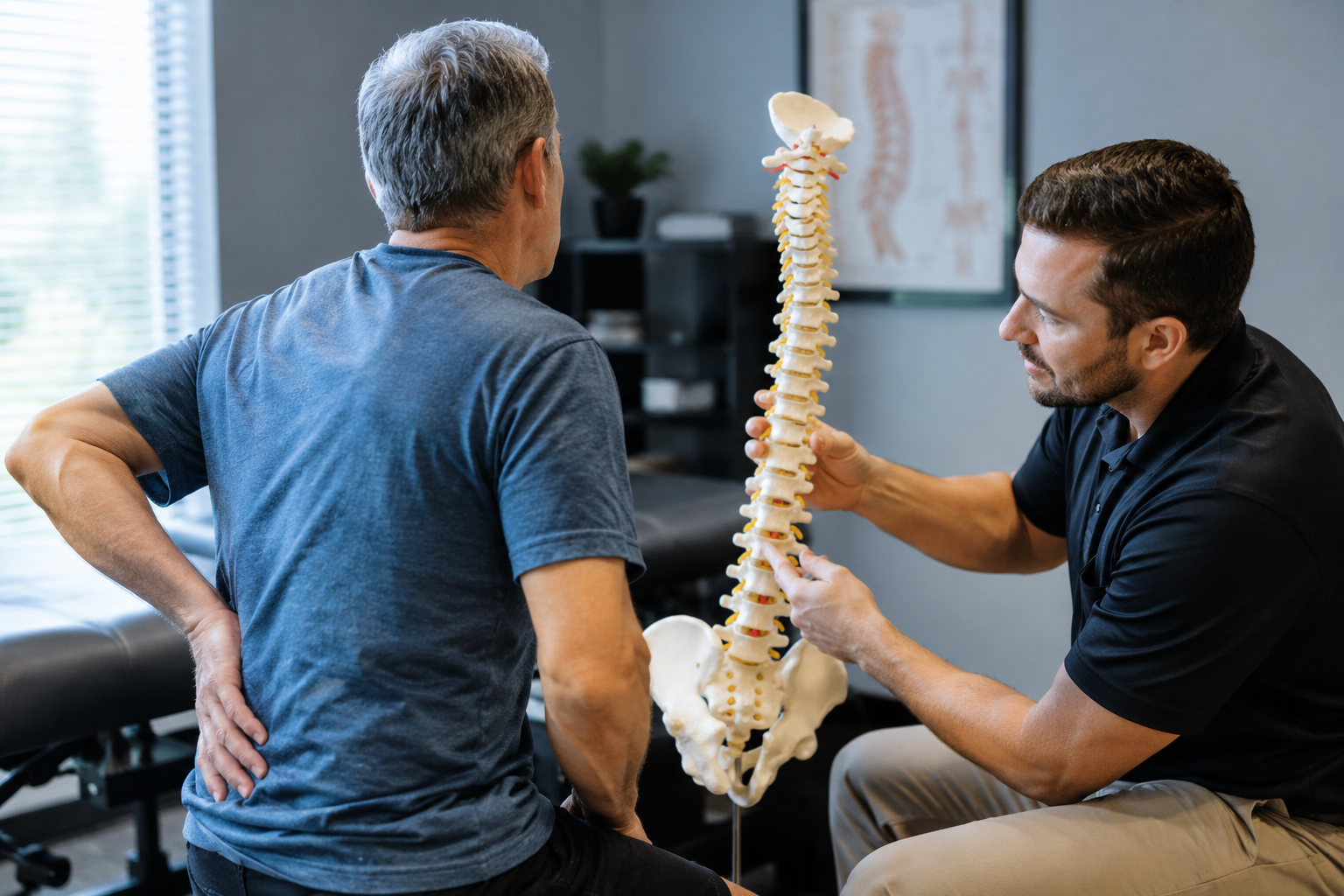
Back pain can make everyday activities, from sitting at a desk to walking through the grocery store, more difficult than they should be. For adults over 40, persistent discomfort may raise concerns about degenerative disc disease, a bulging disc, or a herniated disc. Although these terms are often used interchangeably, they describe different changes in the spinal discs.
Understanding the difference between a bulging disc and a herniated disc is an important step toward choosing appropriate treatment. The location of the affected disc, the degree of nerve involvement, and the symptoms a person experiences all help determine the best approach to care.
At Complete Performance Chiropractic, our focus is on understanding the potential causes of spinal pain and exploring conservative treatment options when appropriate. With an individualized assessment, patients can better understand their condition and make informed decisions about protecting their spinal health.
What Is a Spinal Disc?
Spinal discs are cushions located between the bones, or vertebrae, of the spine. They help absorb forces during everyday movements, support flexibility, and allow the spine to bend and twist.
Each disc has two main components:
Nucleus pulposus: The soft, gel-like center that helps distribute pressure.
Annulus fibrosus: The stronger outer ring of fibrous tissue that surrounds the center.
Over time, aging, repetitive stress, injuries, and natural degenerative changes can affect these structures. Discs may lose some of their water content and flexibility, making them more vulnerable to changes in shape or damage.
However, disc abnormalities do not always cause pain. Some people have bulging or herniated discs without noticeable symptoms, while others experience discomfort, numbness, tingling, or weakness when nearby nerves become irritated or compressed.
What Is a Bulging Disc?
A bulging disc occurs when a spinal disc extends beyond its usual boundaries. The outer portion spreads outward, often around a broad area of the disc, rather than remaining within its normal shape.
Common Causes of Bulging Discs
Bulging discs are frequently associated with age-related degeneration. As discs lose hydration and structural resilience, they may gradually change shape.
Other contributing factors can include:
Repetitive bending, lifting, or twisting.
Prolonged sitting and limited movement.
Excessive mechanical stress on the spine.
Previous spinal injuries.
Changes in posture and movement habits.
A bulging disc may develop gradually, so some people do not notice symptoms until the surrounding structures become irritated.
Symptoms of a Bulging Disc
Symptoms depend on the disc’s location and whether nearby nerves are affected. Some people experience localized neck or lower back discomfort, while others develop radiating symptoms.
A bulging disc in the lumbar spine may contribute to lower back pain or leg symptoms if it affects a nerve root. In the cervical spine, it may be associated with neck discomfort, shoulder pain, or symptoms extending into an arm.
Importantly, a bulging disc does not automatically mean that a nerve is compressed or that treatment is necessary. A clinical assessment helps establish whether the imaging findings are consistent with the patient’s symptoms.
What Is a Herniated Disc?
A herniated disc occurs when the inner material of a spinal disc pushes through a weakened or damaged area of its outer ring. Unlike a typical bulging disc, which involves outward extension, herniation involves displacement of disc material through the outer layer.
Common Causes of Herniated Discs
Herniated discs can develop through gradual degeneration or sudden injury. Age-related changes may weaken the outer disc, while lifting heavy objects, awkward twisting, or repetitive strain can contribute to disc damage.
Symptoms vary depending on the location and severity of the herniation. Some people experience localized back pain, while others develop sciatica, tingling, numbness, or muscle weakness.
Bulging Disc vs. Herniated Disc: Key Differences
Although both conditions involve changes in disc structure, the main distinction is how the disc material extends beyond its normal boundaries.
Bulging disc: The disc extends outward over a broader area without necessarily tearing through its outer layer.
Herniated disc: Disc material protrudes through a weakened or damaged portion of the outer ring.
Neither diagnosis automatically determines how severe symptoms will be. A relatively small herniation may irritate a nerve, while a larger bulge may cause no noticeable discomfort.
Why Getting the Right Diagnosis Matters
Identifying the Source of Pain
Back pain can result from several conditions, including degenerative disc disease, spinal arthritis, muscle strain, or nerve compression. Similar symptoms do not always indicate the same underlying problem.
Our team considers symptom patterns, medical history, movement limitations, and relevant examination findings when determining appropriate next steps. Imaging, such as an MRI, may be recommended by a qualified medical provider when clinically indicated.
Understanding Nerve Involvement
A disc abnormality becomes especially important when it affects nearby nerve roots. Lumbar nerve irritation can cause sciatica, with pain extending into the buttock or leg. Cervical nerve compression may produce neck pain that travels into the shoulder or arm.
Progressive weakness, new loss of coordination, or numbness in the groin area requires urgent medical evaluation. Loss of bladder or bowel control alongside back pain may indicate a medical emergency.
Conservative Treatment Options for Disc Problems
Treatment depends on the diagnosis, symptom severity, and individual health needs. Many people can initially explore conservative care, although some conditions require specialist assessment or surgery.
Chiropractic Care
Appropriate chiropractic care may help address certain movement restrictions and mechanical contributors to discomfort. Techniques should be selected according to the patient’s condition, symptoms, and examination findings. Forceful manipulation may not be suitable for every disc problem.
Axial Spinal Decompression
At Complete Performance Chiropractic, non-surgical spinal decompression is available for selected patients. This treatment uses controlled traction intended to reduce mechanical loading on spinal structures. A thorough evaluation helps determine whether it may be appropriate for a particular disc condition.
Class IV Laser Therapy
Class IV Laser Therapy uses therapeutic light wavelengths and may help manage pain and inflammation in some musculoskeletal conditions. Our clinic offers this non-invasive service as part of individualized care when appropriate. It does not replace a proper diagnosis or guarantee that a damaged disc will heal.
Everyday Habits That Support Spinal Health
Alongside appropriate professional care, several habits may help support comfort and mobility:
Take regular movement breaks during prolonged sitting.
Use controlled lifting techniques and avoid twisting while carrying heavy objects.
Maintain comfortable, regular physical activity suited to your abilities.
Follow a clinician-approved exercise plan to support strength and flexibility.
Seek professional advice if pain persists, worsens, or begins spreading into an arm or leg.
Frequently Asked Questions
1. Is a bulging disc worse than a herniated disc?
Not necessarily. The severity of symptoms depends on nerve involvement, inflammation, and the structures affected rather than the diagnosis alone.
2. Can a bulging disc become a herniated disc?
Disc changes can progress, but this does not happen in every case. Age, disc structure, and mechanical stress may influence how a condition develops.
3. Do all herniated discs require surgery?
No. Many people improve with conservative treatment. Surgery may be considered when significant symptoms persist or serious neurological problems develop.
4. Can an MRI confirm a disc problem?
An MRI can show disc abnormalities and their relationship to nearby nerves. However, findings must be interpreted alongside symptoms and clinical examination because some abnormalities cause no pain.
5. Is spinal decompression appropriate for every disc condition?
No. Spinal decompression may be considered for selected patients, but suitability depends on the diagnosis, medical history, and examination findings.
6. When should I seek medical attention?
Seek urgent care for progressive weakness, saddle-area numbness, or new bladder or bowel dysfunction. Persistent pain, numbness, or tingling also warrants professional assessment.
Conclusion
Understanding the difference between a bulging disc and a herniated disc can help you make informed decisions about spinal health. Although these conditions are related, their effects vary from person to person. An accurate assessment helps identify potential sources of pain and determine which treatment options may be appropriate.
At Complete Performance Chiropractic, our approach emphasizes individualized evaluation and conservative spinal care when suitable. Our services include chiropractic care, Axial Spinal Decompression, and Class IV Laser Therapy for selected patients.
If persistent neck or back pain is interfering with your daily activities, contact us to schedule a consultation. Our team can help you understand your symptoms and explore appropriate next steps.
Complete Performance Chiropractic
📍 Address: 3920 S Old Highway 94, Suite 33, Saint Charles, MO 63304, United States
📞 Phone: (636) 925-1919
🌐 Website: drleitman.com
Take the next step toward understanding your spinal health and finding a care approach suited to your needs.